Kinetic Evolution Engine Cookbook - The Blueprint Lie
Why Your Supply Chain Needs a Combat Manual, Not a Consulting Deck

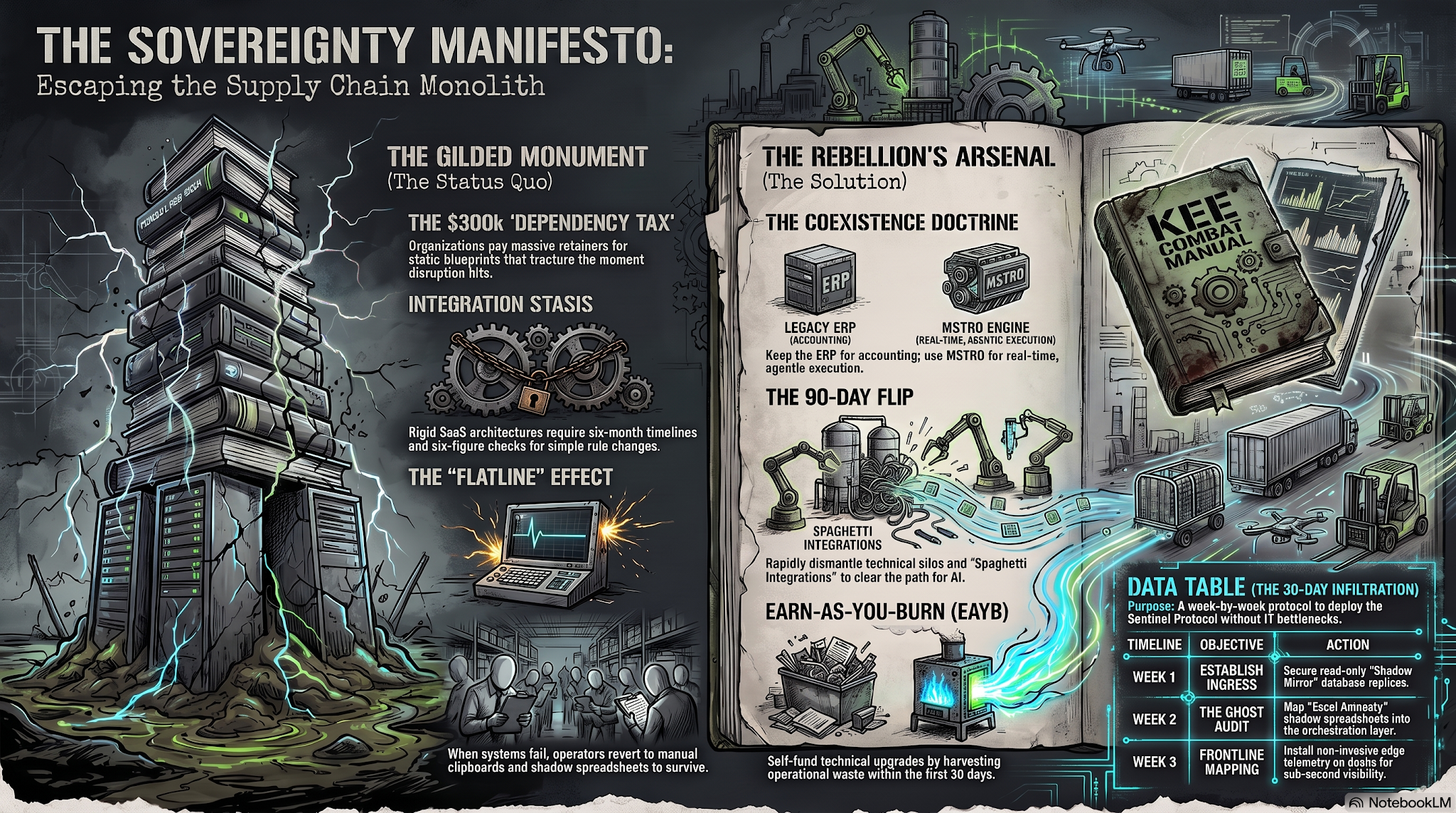
The Gilded Monument
Every year, enterprise supply chain leaders pay millions of dollars to participate in a predictable, high-stakes piece of corporate theatre.
An elite global advisory firm is hired to orchestrate your “digital transformation.” For six months, a small army of junior consultants walks your halls, interviews your directors, and populates complex spreadsheet templates. They construct massive, three-hundred-slide “to-be” process architectures—pristine, hyper-logical diagrams detailing how your warehouse, transport, and inventory planning systems will work in a world of absolute, static harmony.
They call this the “System Blueprint.” They present it in a beautifully bound deck, collect their final six-figure check, and walk away.
And that is where the disaster begins.
The core flaw of the consulting blueprint is that it is a monument to a world that does not exist. It is designed for a static, predictable business environment. But we are living in an era of continuous, volatile disruption. We are navigating the absolute infancy of the Artificial Intelligence revolution, where Large Language Models, edge telemetry, and agentic optimization are expanding in capability every single quarter.
As legendary heavyweight champion Mike Tyson famously observed: “Everyone has a plan until they get punched in the mouth.”
Your three-hundred-slide consulting blueprint is that perfect plan. The real-world supply chain is the fist.
The moment a physical shock hits your floor—whether it is a customs strike gridlocking the border at Laredo, a sudden tariff adjustment, or a local power surge that knocks out your warehouse Wi-Fi network—the punch lands, and the pristine configuration of your blueprint fractures instantly.
Because your enterprise software stack is rigid and locked behind proprietary Cloud-SaaS architectures, you cannot adapt. If you want to modify a warehouse routing rule, integrate a new regional carrier, or inject a localized AI agent to bypass a bottleneck, your software vendor demands a six-figure change order and a six-month timeline to execute the update.
Faced with this integration stasis, your frontline operators do the only thing they can do to keep the business breathing: they abandon the software.
Mac, your veteran yard supervisor, throws his lagging terminal in his cabin and pulls out a manual paper clipboard to direct yard transit by memory. Dave, your master inventory planner, retreats to a password-protected, two-megabyte shadow Excel spreadsheet to route raw materials because your core ERP is lag-blind.
Your multi-million-dollar technology rollout has just flatlined on the concrete. Your system is “always up-to-date” in the cloud, but your physical execution has completely reverted to manual workarounds. You are paying a permanent “Inertia Tax” to a legacy software conglomerate and an endless consulting retainer to systems integrators just to manage the fallout.
We reject this dependency loop.
Your supply chain does not need another theoretical consulting deck. It needs a combat manual. It needs the KEE (Kinetic Evolution Engine) Implementation Cookbook.
The Doctrine of Creative Destruction on the Dirt
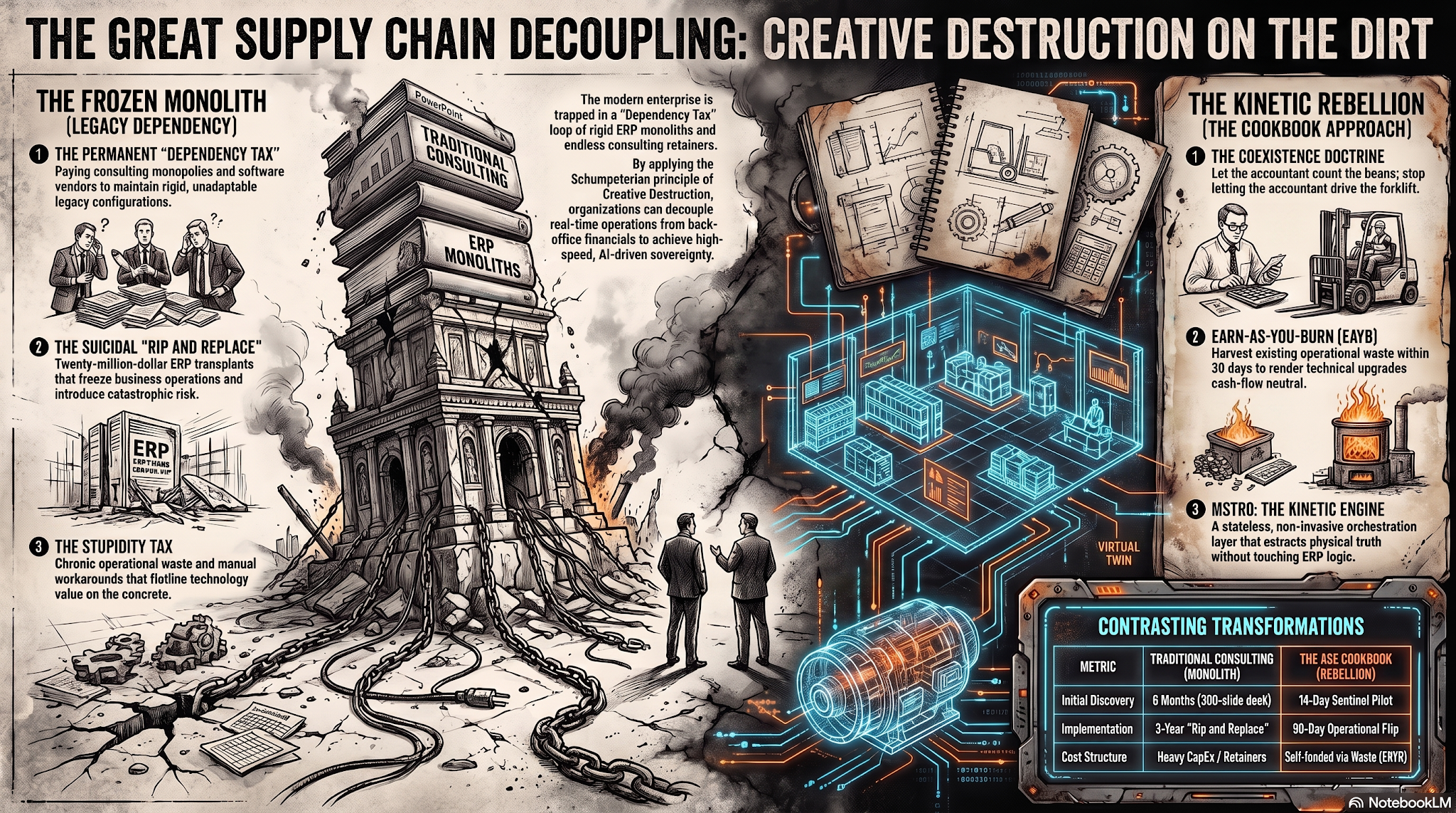
To survive the velocity of the modern market, the enterprise must stop trying to preserve its frozen, legacy software configurations and instead embrace the economic principle of Creative Destruction.
As formulated by Joseph Schumpeter, creative destruction is the process of industrial mutation that incessantly revolutionizes the economic structure from within, incessantly destroying the old one, incessantly creating a new one.
In the enterprise technology space, this means we must actively dismantle the rigid technical silos, custom point-to-point “Spaghetti Integrations,” and rent-seeking consulting monopolies of the past to clear the path for high-speed, continuous AI evolution.
The KEE Implementation Cookbook is the physical vehicle for this creative destruction. Engineered by the Otis Content Engine, this living operational manual rejects the traditional model of engineered dependency. It does not ask you to execute a suicidal, twenty-million-dollar ERP “Rip and Replace”—which is an operational heart transplant that introduces catastrophic risk and freezes your business for three years.
Instead, the Cookbook applies the Coexistence Doctrine:
Let the accountant count the beans. Just stop letting the accountant drive the forklift.
Your core ERP is an exceptional financial ledger. It is secure, heavily audited, and highly compliant. Keep it in the back office to run your financials. But strip it of its authority over real-time operational execution.
By layering a lightweight, non-invasive System of Action around your ledger, you can extract the physical truth of your operations without ever touching the fragile core database logic of the ERP. You get the bulletproof compliance of your ledger in the back office, and the raw, adapting speed of agentic AI on the concrete.
And through our foundational Earn-As-You-Burn (EAYB) framework, the Cookbook shows you how to harvest existing operational waste (our chronic “Stupidity Tax”) within the first thirty days to completely self-fund your technical upgrades, rendering the entire transformation cash-flow neutral.
Grounding the Tech: What is MSTRO?
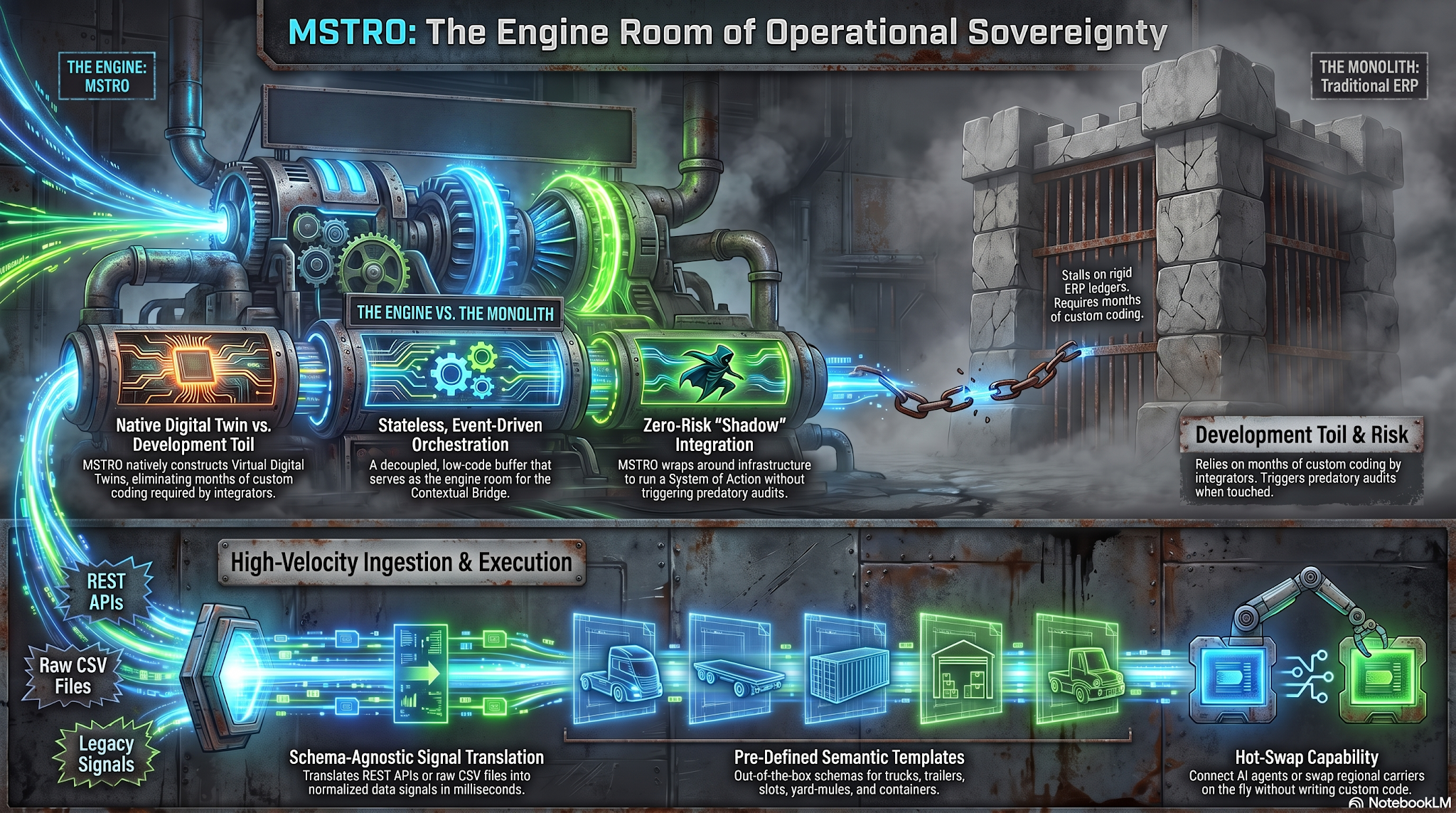
To run a high-velocity System of Action without touching your core ledger, you need a specialized technical engine. This is where MSTRO enters the arena.
MSTRO is not a passive data lake, a visual business intelligence tool, or another rigid enterprise database. It is a stateless, event-driven orchestration platform that wraps around your existing infrastructure to serve as the physical engine room of the Contextual Bridge.
Traditional software projects stall because systems integrators spend months writing custom code to build a “digital twin.” MSTRO entirely eliminates this development toil because it natively constructs the Virtual Digital Twin within its own architecture.
Right out of the box, MSTRO delivers pre-defined semantic templates and standardized data schemas representing the physical objects on your floor—the trucks, trailers, slots, yard-mules, containers, and SKUs. MSTRO’s ingestion engine is completely schema-agnostic: whether a partner transmits data via a modern REST API or dumps a raw CSV file into an SFTP folder, MSTRO translates and normalizes the signal in milliseconds.
By serving as a decoupled, visual, low-code operational buffer, MSTRO allows your team to connect next-gen AI agents, onboard new suppliers, or swap regional carriers on the fly without writing custom code or triggering predatory ERP software audits. MSTRO provides the technical execution vehicle that turns the Cookbook’s strategic plays into real-world frontline velocity.
What’s Inside: The Cookbook’s Tactical Recipes
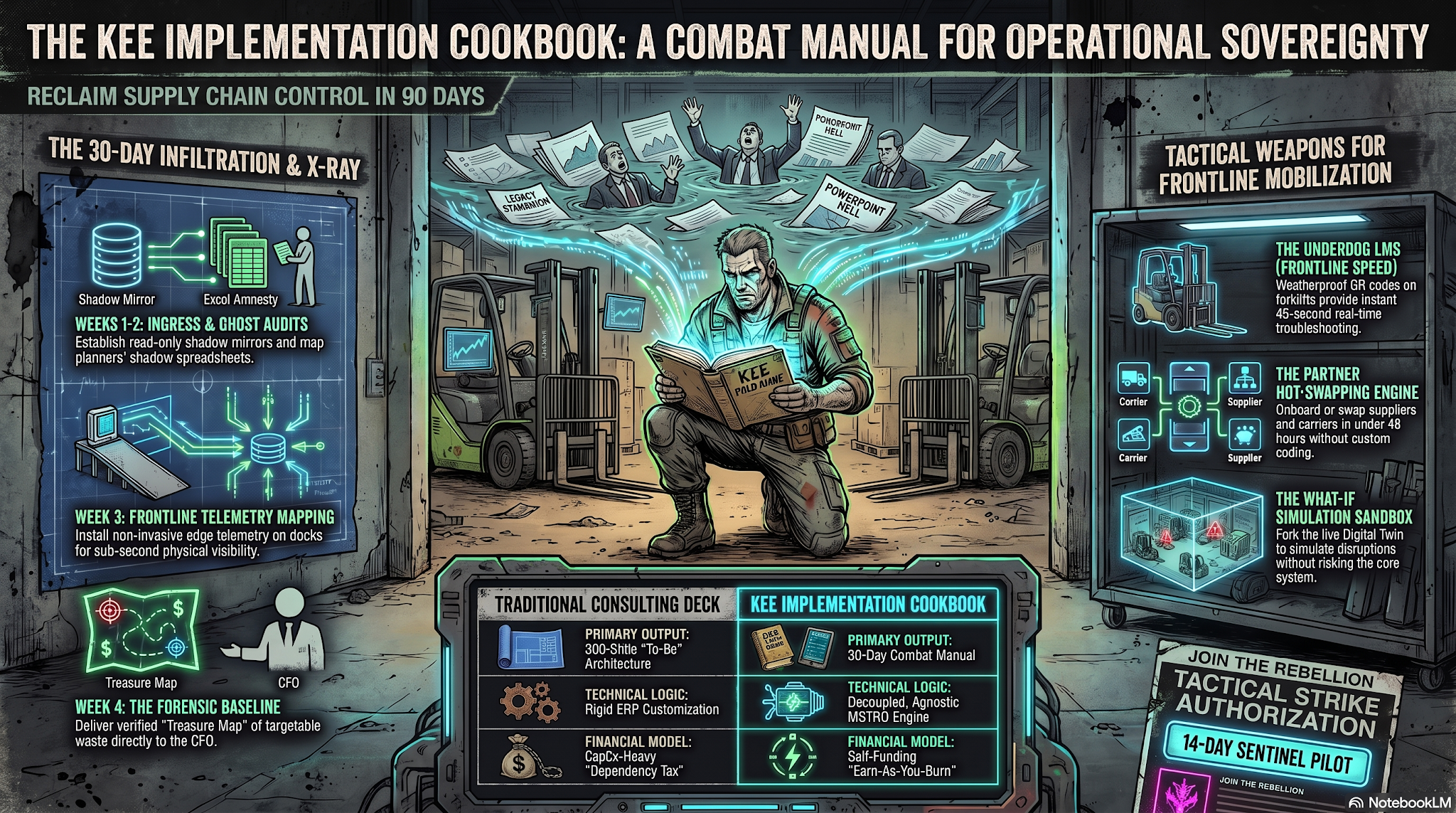
The KEE Implementation Cookbook is a gritty, step-by-step field guide packed with the exact task schedules, persona playbooks, forensic audit sheets, and conditional triggers your internal team needs to execute the 90-Day Flip and reclaim your operational sovereignty.
Here is a preview of the tactical weapons and recipes contained within the Cookbook:
1. The 30-Day Infiltration & X-Ray Schedule
The Cookbook details the exact week-by-week protocol to deploy the non-invasive Sentinel Protocol and construct a Virtual Digital Twin of your physical network—without IT bureaucratic bottlenecks or database risk:
Week 1 (Establish Ingress): Secure read-only database replicas (the Shadow Mirror) or configure fifteen-minute flat-file shadow exports to ingest raw data streams.
Week 2 (The Ghost Audit): Conduct “Excel Amnesty” interviews to map your planners’ active shadow spreadsheets, translating their formulas into the standard rules of your data orchestration layer.
Week 3 (Frontline Mapping): Install non-invasive edge telemetry and router packet-sniffing protocols on the docks to establish sub-second physical visibility.
Week 4 (The Forensic Baseline): Calculate your exact “Visibility Delta” and deliver a verified “Treasure Map” of targetable invoice and inventory waste directly to the CFO to self-fund the next phase.
2. The Partner Hot-Swapping Engine
A detailed technical guide explaining how to utilize MSTRO’s schema-agnostic, decoupled architecture to completely obliterate the onboarding bottleneck. The Cookbook provides visual semantic mapping rules that allow your team to onboard or swap new suppliers, regional carriers, and 3PL WMS modules in under forty-eight hours without custom ERP coding. This creates a unified “operating system face” that dramatically simplifies mergers, acquisitions, and scaling.
3. The Underdog LMS (Frontline Mobilization)
Traditional change management fails because operators reject complex new software screens. The Cookbook provides the blueprint for the Underdog LMS—bypassing classroom training entirely by mounting weatherproof QR codes directly onto forklift roll-cages and yard-mule dashboards. Operators scan the code at the moment of a system exception to instantly play a silent, 45-second visual video showing them how to clear the error in real-time on the dirt, reducing exception-handling latency from ten minutes to seconds.
4. The What-If Simulation Sandbox
A tactical blueprint detailing how to run risk-free operational simulations. Because MSTRO operates on an isolated replica entirely separate from your System of Record, the Cookbook shows your team how to “fork” the live Virtual Digital Twin to simulate the cascading impact of disruptions (such as a port strike or carrier failure) across parallel tracks, mathematically proving the margin-optimal path before spending a single dollar.
5. Conditional Operational Triggers
Pre-vetted, automated rules of engagement for your internal strike team (the Kinetic Operations Cell). The Cookbook contains precise formulas and logical boundaries that automatically trigger rapid-response carrier dispatches, inventory re-allocations, and safety stock adjustments the second the Digital Twin detects operational drag.
💎 THE KINETIC EVOLUTION ENGINE GEM
The Sovereignty Manifesto: Blueprints are Rented, Blueprints are Bought
Traditional management consulting models thrive on your compliance and your permanent technical dependency. They sell you a “transformation,” but they install an umbilical cord tied directly to their billing department.
The Otis Content Engine rejects this parasitism.
We believe that a true digital transformation is not complete until the client has cut the consulting cord and assumed complete, sovereign control over their own data, their own code, and their own people.
The KEE Implementation Cookbook is our ultimate weapon to achieve this. We do not build black boxes; we build engines and give you the blueprints. We do not rent you our expertise; we upskill your team to command their own velocity.
Sovereignty is taken, not rented. Activate the engine, take the wheel, and let your team run the future of your network.
Take the Wheel: The 14-Day Sentinel Pilot
The age of endless IT assessment cycles and three-hundred-slide discovery decks is over. If your technology is rigid, your physical supply chain is fragile under disruption. You cannot afford to wait six months for an IT steering committee to authorize a change ticket.
We do not ask for a multi-million-dollar commitment to prove our value. We invite forward-looking leadership teams to authorize a 14-Day Sentinel Pilot—a zero-risk, non-invasive tactical strike designed to expose your hidden liquidity and demonstrate the immediate, decoupled speed of the MSTRO architecture.
We will establish non-invasive data ingress, instantiate your Virtual Digital Twin using out-of-the-box templates, run a forensic audit of your historical waste, and deliver a live demonstration of an automated What-If Simulation Sandbox run—proving exactly how you can orchestrate real-time lane pivots without disturbing your back-office financials.
Stop letting your software dictate the speed of your execution. Defuse the integration tax, silence the consulting dependency loop, and take back the keys to your operational sovereignty.
Activate the engine. The Cookbook is ready. Let’s get moving.
Let’s continue in the comments:
Look at your current consulting and systems integration retainers. What is the exact “Dependency Tax” your organization is paying just to keep your technology running?
If your team was handed the complete, un-gated blueprints to your operational data and telemetry tomorrow morning, what is the very first AI capability you would deploy to the concrete?